 sortiwa
Forward-looking: Elon Musk has been talking about orbital data centers for quite a while now. With the company’s IPO expected to price tomorrow and begin trading Friday, the SpaceX CEO has unveiled details about the 150 kW AI1 satellite, which spans nearly 230 feet when deployed.
SpaceX says the first-generation AI1 design is 20 meters tall (65.6 feet) and has a 70-meter (229.6-foot) deployed wingspan, making it wider than a Boeing 747-8.
The satellite is designed to deliver 120 kW of sustained compute payload and 150 kW at peak, or roughly 70 kW per ton, while operating in low Earth orbit at 600 kilometers (372.8 miles).
– SpaceX (@SpaceX) June 8, 2026
Musk compared the power draw to a single Nvidia GB300 rack, which is rated at 140 kW. Each AI1 satellite is essentially one AI server rack in orbit, wrapped in solar arrays, radiators, communications systems, propulsion, shielding, and enough structure to survive launch and years of vacuum exposure.
The compute section is interchangeable, meaning SpaceX could use Nvidia GPUs at first and later swap in other silicon as better options appear.
SpaceX CFO Bret Johnsen said the initial orbital data centers will use Nvidia hardware, while longer-term versions are expected to rely on radiation-hardened chips from Terafab, the semiconductor project SpaceX is developing with Tesla and Intel.
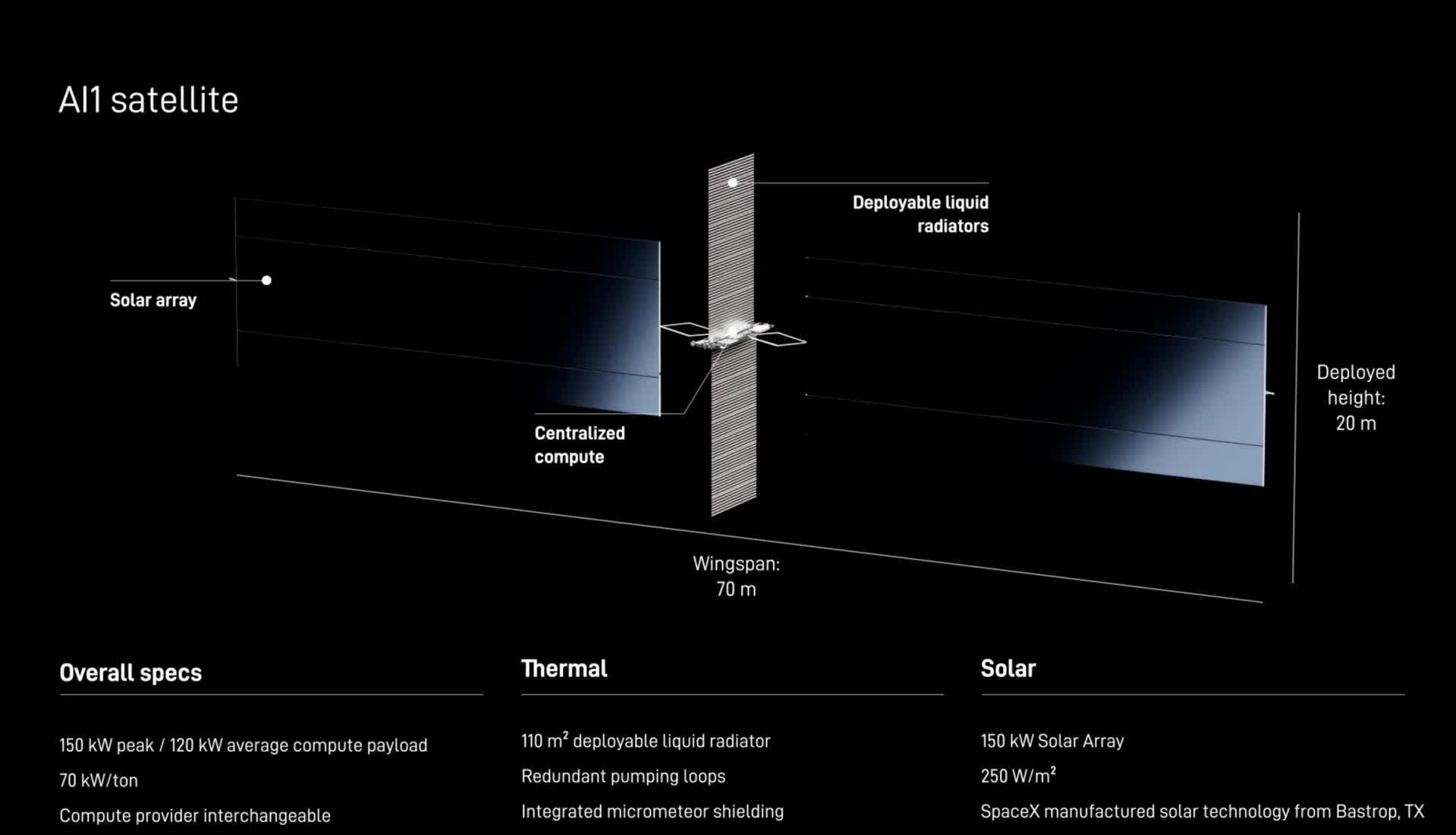
Cooling is the other obvious challenge. On Earth, hot AI racks rely on air, water, or liquid loops. In space, there is no atmosphere to dump heat into, so AI1 has to radiate waste heat away as infrared energy.
The design includes up to 110 square meters (1,184 square feet) of deployable liquid radiators, redundant pumping loops, and micrometeoroid shielding. The coolant is unlikely to be water, with ammonia a more plausible spacecraft cooling fluid.
Musk insists this is not a moonshot by SpaceX standards. The company says AI1 leans heavily on Starlink V3 technology, including solar arrays and thermal-management systems. Engineer Ian Dahl described the design as simpler than a Starlink broadband satellite because it doesn’t need the same large phased-array antennas.
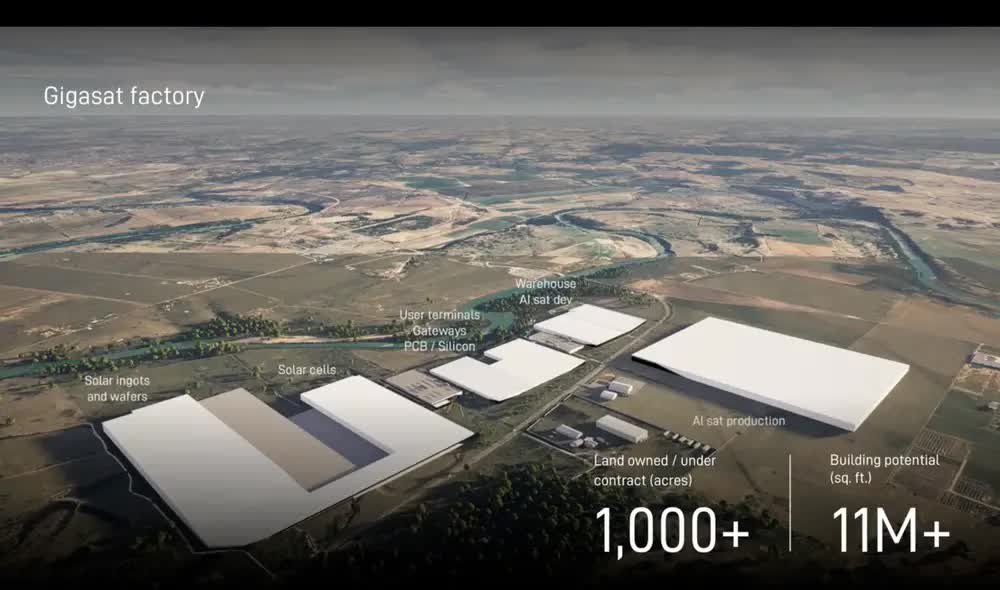
The solar panels are expected to come from SpaceX’s newly unveiled 11-million-square-foot Gigasat factory in Bastrop, Texas, which Musk says should reach meaningful output by the end of next year.
The reusable Starship rocket is the other piece of the plan, as SpaceX says its design will be needed to launch enough solar panels, radiators, and chips.
SpaceX has already tied its xAI merger to a plan for up to 1 million orbital data-center satellites, while its IPO filing pitches rockets, Starlink, AI, and Mars as parts of the same business. The company reported $18.7 billion in revenue last year but also a $4.94 billion net loss.
The AI1 reveal is as much an IPO pitch as a technical roadmap. SpaceX is seeking to raise around $75 billion at a valuation of about $1.75 trillion, with shares expected to trade on Nasdaq under the ticker SPCX.
Source link


