 sortiwa
The big picture: OpenAI is trying to do two things at once: persuade public-market investors it deserves a trillion-dollar valuation, and show that ChatGPT can be more than a clever chatbot. Taken together, the IPO move and the product overhaul show how the company is working to convert its early lead in generative AI into a lasting business.
The company said Monday it has confidentially filed for a US initial public offering, joining rival Anthropic in lining up for a market debut as investors search for ways to bet on the AI boom. OpenAI did not disclose the size or timing of the deal and signaled it is in no rush, saying “it may be a while because there are things we want to do that are likely easier as a private company.”
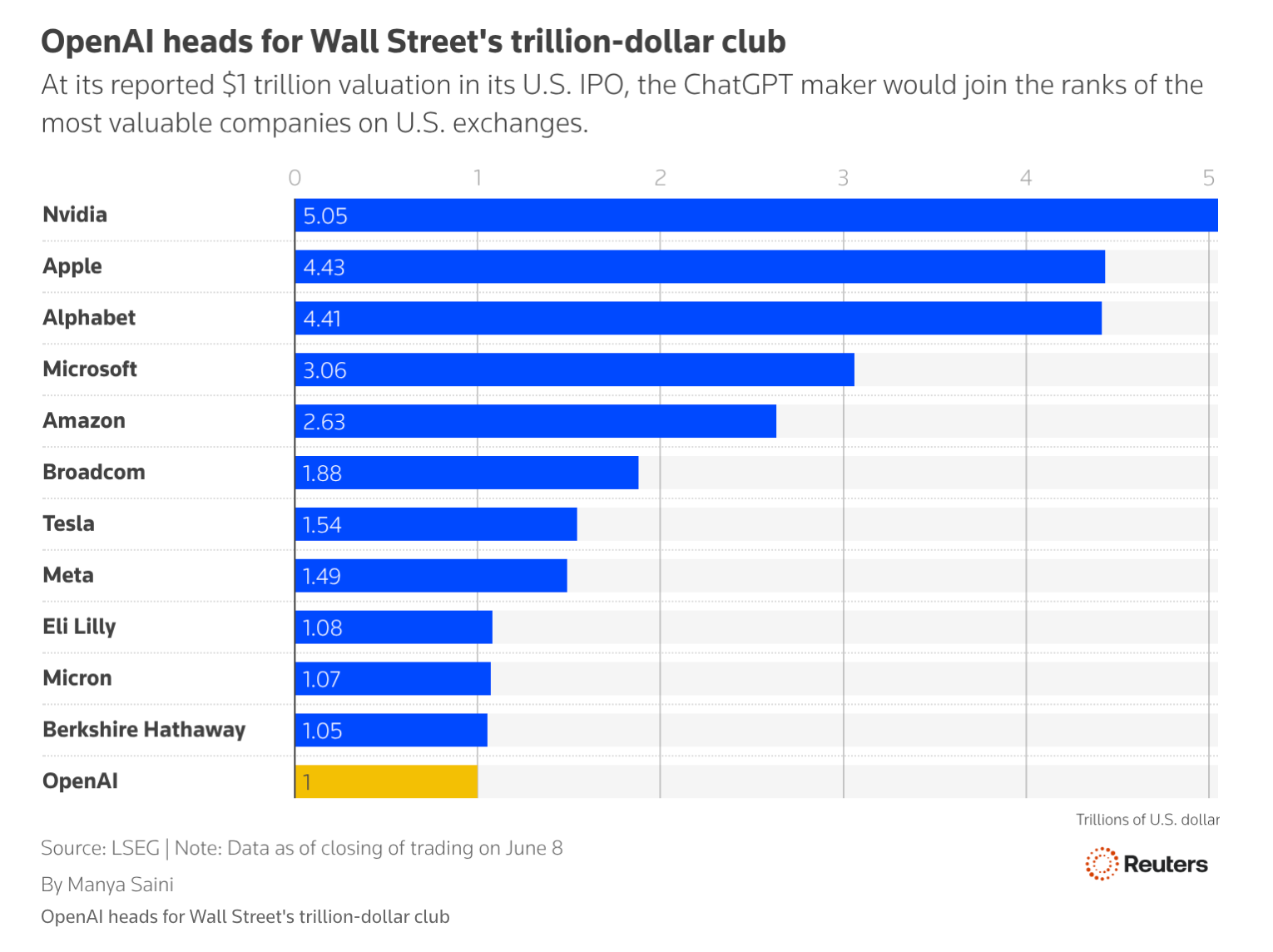
Even without a prospectus, expectations are already inflated. Reuters reports that OpenAI is targeting a valuation of up to $1 trillion in an offering that could come as early as September – a level that would place it among the largest technology listings in history and test just how much public investors are willing to pay for AI growth.
Earlier this year, OpenAI told investors it planned to raise about $110 billion at a roughly $840 billion valuation, with SoftBank, Amazon, and Nvidia among the backers.
A $1 trillion valuation would make OpenAl the world’s 14 biggest company.
The numbers around the business are moving fast. OpenAI told investors in March that it was generating $2 billion in monthly revenue, up from around $1 billion in quarterly revenue at the end of 2024, and that growth was running roughly four times faster than earlier generations of internet and mobile leaders such as Alphabet and Meta. The company has also told backers it does not expect to be profitable until 2030.
Credit: Reuters
The IPO filing follows a broader reshaping of OpenAI’s capital and partnership structure. The company renegotiated its agreement with Microsoft, one of its earliest and largest investors, in a way that preserves the software giant’s role while giving OpenAI more room to work with other cloud and platform partners, including Amazon and Google. Microsoft has poured about $13 billion into OpenAI since 2019, support that has underpinned both the AI group’s rise and the growth of Microsoft’s Azure cloud business.
OpenAI’s move toward the public markets comes just as Anthropic, the company behind Claude AI models, is taking a similar path. On June 1, Anthropic said it had confidentially filed for a US listing, only weeks after a $65 billion funding round that valued the company at roughly $965 billion. “OpenAI is keeping options open as Anthropic edged ahead with its filing after a monster funding round,” Michael Ashley Schulman, a partner at Cerity Partners, told Reuters.
While the funding and filings draw headlines, the more consequential work for OpenAI may be happening inside. The company is preparing what executives describe as the biggest overhaul of ChatGPT since its 2022 launch, with the goal of turning the service into a “superapp” that brings together coding tools, AI agents, and third-party services. The strategy is to move beyond static chat and lean into agents that can take actions on a user’s behalf.
“Chat is dead,” one senior OpenAI employee told the Financial Times, reflecting a growing internal view that simple Q&A interfaces are a stepping stone rather than a destination. Inside the company, ChatGPT – now approaching 1 billion users – is seen less as an end product and more as a funnel toward higher-value services.
Most users still rely on the free version of the chatbot, but products such as Codex, which can write and build software from natural-language instructions, are more directly tied to revenue.

Thibault Sottiaux, who previously ran Codex and now oversees OpenAI’s core product and platform, described the direction in expansive terms. “It will transcend the actual surface… what we’re building towards is where you have your own personal agent that is capable of helping you… across everything in your life, be it personally or at work,” he said. “You can connect through it on your mobile, desktop or web. When you’re in the car, you can talk to it.”
Behind that vision is a push into enterprise. Around 2 million companies now use OpenAI’s products, accounting for roughly 40% of revenue; the company expects that share to rise to about half by year-end. Codex has grown its user base sixfold to more than 5 million weekly active users since a desktop app launched in February, putting OpenAI in sharper competition with Anthropic’s fast-growing Claude Code product.
OpenAI has reorganized its product structure, folding ChatGPT, Codex, and other efforts under a single leadership team led by Sottiaux. Some consumer-oriented experiments have been shelved, including a checkout feature inside ChatGPT and the Sora video-generation app, which was shut down after roughly six months. The focus now is on a single assistant that can move across domains: coding, search, productivity, and more, as the underlying models gain the ability to infer intent and handle multi-step tasks.
Executives also see that direction as part of a longer-term bet on AGI and how users will interact with it. “When we have [artificial general intelligence], I don’t think there will be a large number of distinct brands,” said Alex Embiricos, OpenAI’s head of enterprise product. “Probably there will be a single entity that I can talk to that can do whatever I need.”
Source link


